The Story of Spyglass
A story about direction, curiosity, and a long path that quietly made sense
Some software is created to meet a requirement.
Some is created to fill a gap.
Spyglass was created because one person felt a persistent need to build it — and when the technology finally made it possible, he brought it to life without hesitation.
This is not a story about features or growth charts. It's a story about time — about how ideas form, wait, and return when the world is finally ready for them.
What follows is a chronological walk through that path, from the very first encounter with a computer to the tool Spyglass has become today:
→ 1) 1986: the first computer
→ 2) When software became a destiny
→ 3) Interfaces from the future
→ 4) The first iPhone moment
→ 5) 2009: the compass sensor
→ 6) Prototype, first release, first download
→ 7) When Apple noticed
→ 8) Accuracy under the surface
→ 9) 2010: from experiment to instrument
→ 10) Long maintenance, quiet continuity
→ 11) Where Spyglass is today
→ About the app's creator
1) 1986: the first computer
In 1986, Pavel Ahafonau encountered his first computer.
It wasn't just curiosity. It was something more immediate and harder to explain: a clear sense that he needed to become someone who could make computers do what he needed. Not simply operate them, but shape their behavior.
That moment quietly set a direction.
2) When software became a destiny
That early pull toward computing didn’t weaken with time.
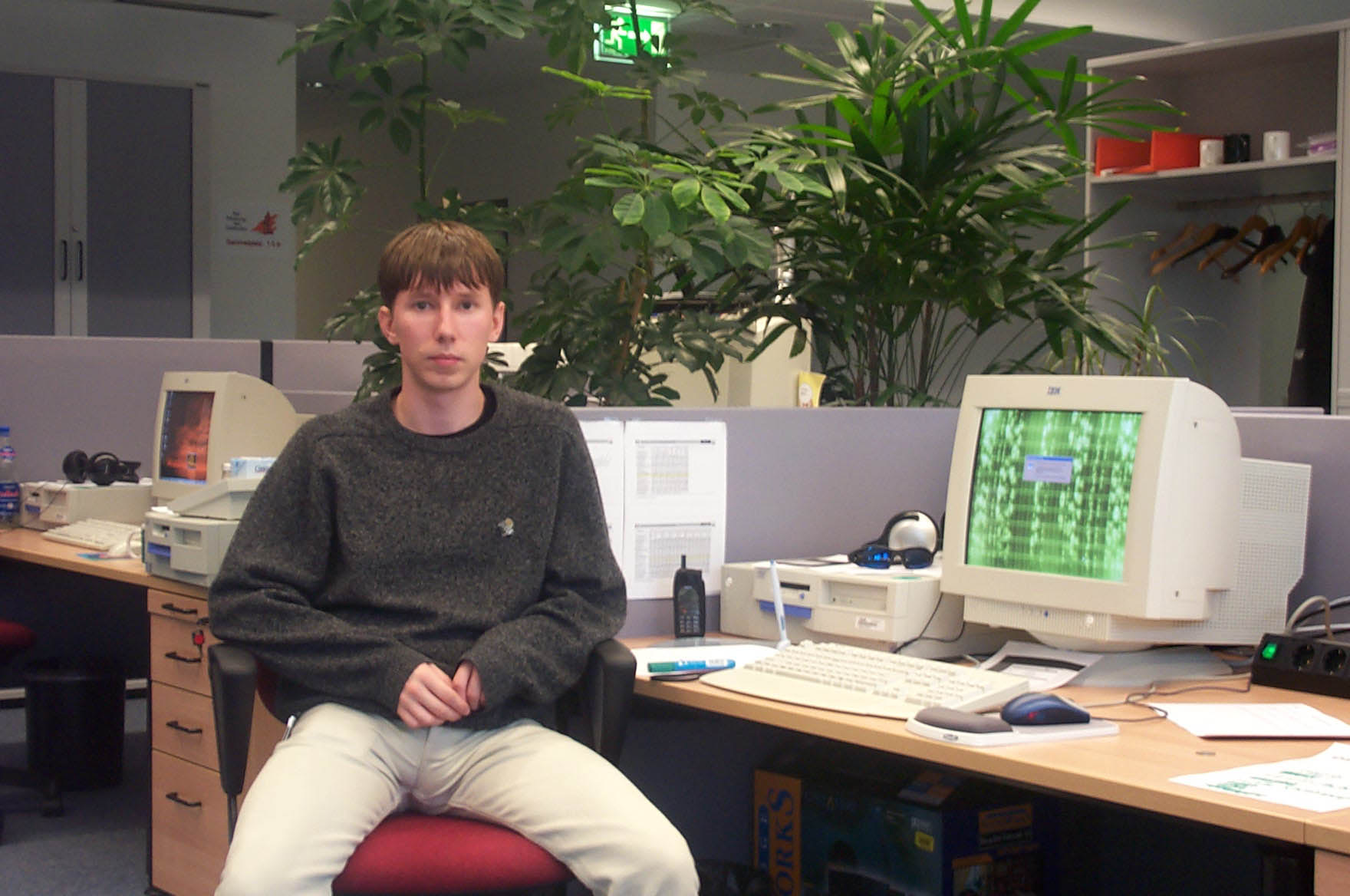
Pavel moved from curiosity to practice, and then to professional work. He began working full time as a software engineer at IBM before completing his higher education, dealing with real systems, real constraints, and real responsibility while formal studies continued alongside.
Before joining IBM, Pavel already had extensive experience with Unix-like operating systems, including IBM AIX, Linux, and FreeBSD. Since 1997, he has been a member of the “UNIXOID” club, a community centered around Unix systems and culture. He was also a co-founder of a local Linux Users Group, regularly gave internal lectures to colleagues, and developed software across these platforms. Part of this work was contributed to public free software projects, including code committed to the FreeBSD Ports collection (for example, libcyrillic).
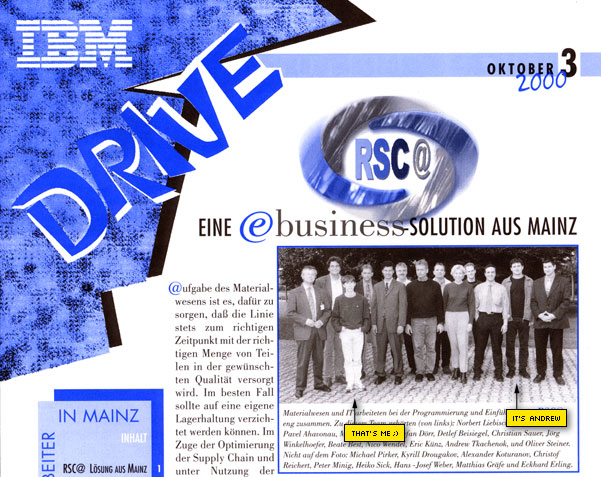
During his time at IBM, Pavel participated in a large internal enterprise project. His contribution to that work was later described in an IBM internal newspaper, and he received an internal IBM recognition award related to the project.
This background in Unix systems, low-level development, and highly optimized software later proved directly applicable when working on iOS and macOS, whose core architecture is based on the FreeBSD kernel. It helped make the transition from enterprise and systems programming to mobile and desktop platforms a natural continuation rather than a shift.
3) Interfaces from the future
Alongside engineering, there was another steady influence: science fiction.
Not spectacle, but interfaces.
Jet fighter HUDs. Spacecraft panels. Military optics. Robotic vision.
What mattered wasn't fantasy, but the way information was layered over reality — clearly, purposefully, without distraction. These ideas stayed present for years, waiting for hardware that could support them outside fiction.
4) The first iPhone moment
When the first iPhone appeared, Pavel didn't treat it as a trend.
He bought the first iPhone brought into his country. The reaction was immediate and simple:
This is it. The future.
Not because of popularity, but because it was clear what the device represented: a personal computer people would carry everywhere. From the very first model, Pavel followed the platform closely, watching its capabilities grow.
5) 2009: the compass sensor
In 2009, the iPhone gained a compass sensor.
For many users, it was a minor specification. For Pavel, it was a missing piece. The device could now understand direction and orientation, and when paired with the camera, something long imagined became practical: placing direction-aware information directly onto the real world.
As soon as Apple released the SDK, Pavel began experimenting.
There was no plan to build a product — only the sense that something he had carried for years was finally possible.
6) Prototype, first release, first download
Spyglass began as a hobby project.
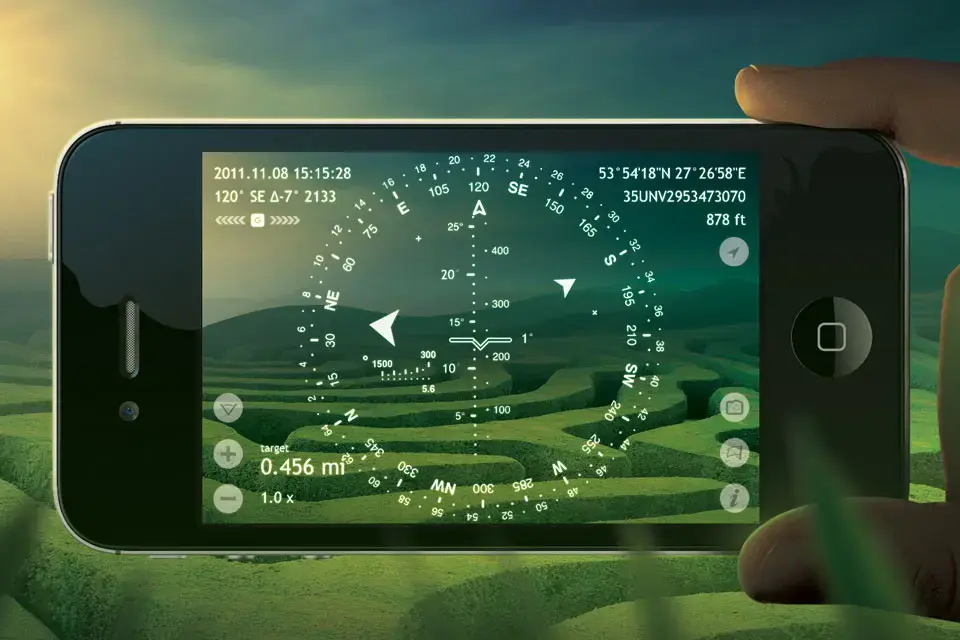
It was a simple HUD application that overlaid compass and location data onto the live camera view. The interface could be tinted in colors reminiscent of sci-fi and military displays — green, red, and others — not for effect, but for clarity.
The early timeline was direct:
- 2009-09-22 — first prototype disclosed on YouTube
- 2009-10-05 — first app release, and the first download
(Early prototype videos published in 2009 and 2010 remain publicly accessible on YouTube)
In its first form, Spyglass turned the iPhone into something like high-tech binoculars — a viewfinder familiar from spy movies and science fiction, now existing in everyday reality.
7) When Apple noticed
Spyglass was among the early augmented-reality apps on iPhone.
It was later featured by Apple in “iTunes Rewind 2010: Hot Trends In Apps” under the Augmented Reality category, and over the years continued to appear in Navigation, Outdoors, Hiking & Camping, Best New Apps, and Essentials features.
But attention wasn't what shaped its direction.
Precision was.
8) Accuracy under the surface
The visible part of Spyglass was the HUD. The important work happened underneath.
Pavel built his own engine that fused data from the device's sensors to improve accuracy. The aim was straightforward but demanding: to ensure that virtual markers aligned with the real world as honestly as possible.
This foundation, developed before the first launch in 2009, allowed Spyglass to grow beyond a visual experiment and become a practical tool.
9) 2010: from experiment to instrument
Development continued quickly.
Within less than a year, guided by Pavel's original ideas and by feedback from early users, Spyglass evolved into a broader toolkit. Many features were shaped directly by people who needed reliable, precise tools in real conditions: law enforcement officers, military and police personnel, search-and-rescue teams, engineers, hunters, sailors, pilots, fishers, astronomers, and navigators.
Their needs were practical, not theoretical — and the app grew accordingly.
Another milestone followed:
- 2010-01-26 — new prototype teased
- 2010-02-10 — released
What distinguished Spyglass from other AR apps of the time was the ability to define custom targets — locations, bearings, even celestial objects — and later find them again using GPS and precise gyroscope-based aiming.
It enabled practical work: aligning antennas, working with bearings, using the sky itself as a reference.
10) Long maintenance, quiet continuity
Spyglass was never handed off.
It was maintained continuously by Pavel, adapted to new devices, new sensors, and changing operating systems. In October 2017, it became available on Android.
Over time, the project existed in three forms:
- Spyglass — with augmented reality features
- Commander Compass — paid, without AR
- Commander Compass Go — free
Eventually, everything was merged into a single app: Spyglass.
Across all versions, total downloads exceeded 10 million.
11) Where Spyglass is today
Today, Spyglass is a mature, multi-layered navigation and orientation tool.
It combines a military-grade compass, gyrocompass, GPS navigation, offline maps, altimeter, speedometer, rangefinder, inclinometer, sextant, and support for multiple coordinate systems, including civilian and military formats. Through augmented reality, it overlays bearings, waypoints, targets, and celestial objects directly onto the real world, turning a smartphone into a precise orientation instrument rather than a simple map.
(Current feature set as described on the App Store and Google Play pages)
Spyglass is used by people who operate beyond marked roads and stable network coverage: hikers and explorers, hunters and fishers, sailors and pilots, engineers and surveyors, astronomers, and navigation professionals. It is also used in demanding environments by law enforcement, military, and search-and-rescue personnel, where clarity and reliability matter more than convenience.
The app continues to evolve at a deliberate pace. New features appear when technology allows them to. Some ideas still wait, because the hardware required for them does not yet exist.
That waiting feels familiar.
It is how Spyglass began.
About the app's creator
Pavel Ahafonau is an independent app developer from Lithuania who has been building and maintaining personal software projects since 1999 as a solo developer, system architect, and designer; across his navigation and network utility apps he has reached over 25 million users, been repeatedly featured by Apple, and covered by publications including TUAW, Engadget, MacLife, Uncrate, Business Insider, BBC, and Adventure Journal.







© 2006—2026 Happymagenta

